The database size doesn't decide this. Two things do: whether logging is fast enough that you still do it on a bad day, and whether your target rises as you gain instead of sitting there going stale.
We build a bulking app, so treat the last section as interested. The first three aren't — the criteria below are the ones we'd use to judge anything, including us.
Most trackers are built for the other direction
Calorie tracking grew up as a weight-loss tool, and the design still shows it. You'll recognize the tells: the number on screen is calories remaining, counting down to zero. Going over turns something red. The daily summary congratulates you for finishing under. The target you got on day one is the target you'll have in month four unless you remember to change it.
None of that is a bug. It's correct design for a dieter and exactly backwards for you. When you're gaining, the number is a floor to clear, not a ceiling to stay under, and hitting it is the win.
The four things that actually matter
1. Logging speed, multiplied
You will log more food, more often, than someone cutting. A tracker that takes forty seconds a meal costs a dieter a minute a day and costs you several. Every extra tap is a reason to skip logging the smoothie, and skipped entries are how you end up believing you ate 3,000 calories on a 2,400 day.
2. A target that moves as you gain
This is the one almost nothing handles. As you get heavier you burn more, so the surplus that was gaining you weight in week one is drifting toward being your new maintenance by week eight. Same food, stalled scale, and the app never says a word. If your tracker can't raise the number, you have to remember to, roughly every month, forever.
3. It has to treat "over" as success
Sounds cosmetic. It isn't. Being told you failed every time you succeed is a slow tax on the habit, and the habit is the whole thing. Nobody keeps using an app that scolds them for doing exactly what they set out to do.
4. Weekly trend, not daily weight
Your weight swings a few pounds on water and food timing alone. A tracker that shows only today's number invites you to react to noise, which is how people abandon a working plan in week two.
How the options compare
MyFitnessPal
The biggest food database in the category, and that's a real advantage — whatever you ate, it's in there. It supports a gaining goal, so you can absolutely bulk on it. What you're accepting is the weight-loss framing throughout and a target that holds still until you go recalculate it yourself. Best for people who eat unusual or restaurant-heavy food and don't mind doing their own target maintenance.
Cal AI and the photo-first trackers
A newer category built on the genuinely good insight that logging friction is the real enemy: photograph the plate, skip the searching. They're general-purpose, so they'll happily point at losing, maintaining, or gaining. You get the speed but not the specialization — the surplus logic, the rate ceilings, and the adapting target are still yours to manage. Best if speed is the only thing you're missing.
Generic and free trackers
Fine as calculators, and free is a real feature. They'll hold a number and count against it accurately. You're supplying everything else: recalculating as you gain, tracking your own trend, and ignoring an interface built for the opposite goal. That admin is exactly what people stop doing in month two.
BulkMode
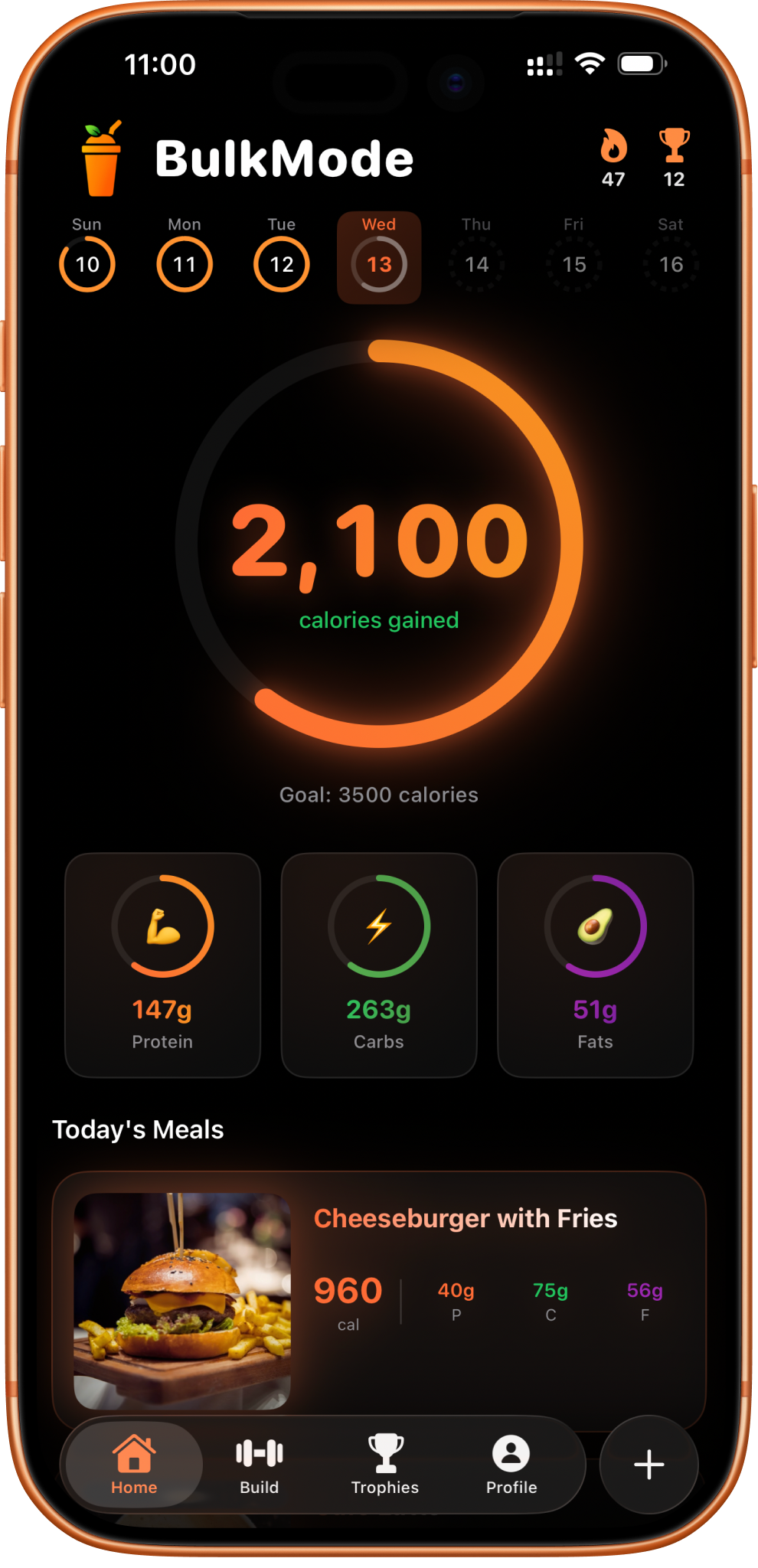
Built for one job. Photograph the meal and you get calories and macros in seconds. Your target starts from a lean-mass formula, eases up over your first five weeks so you're not force-fed on day one, and from around week three it compares what you actually ate against what your weight actually did and rebuilds the number from your own data. Going over never turns red, because going over is the point. If you'd rather drive, you can set your own calories and macros by hand and it will still track your estimated burn against them. Best if you're gaining and want the arithmetic to stop being your job.
When we're the wrong choice
Three cases where you should use something else:
- Cutting is your main goal. Everything here assumes the number is going up — the targets, the on-ramp, the learning, the fact that going over counts as a win. You can override the numbers by hand, but you'd be steering a gaining app against the grain.
- You want a permanently free tracker. BulkMode is a subscription after the trial. If free is the requirement, a general-purpose tracker is the honest answer.
- You track more than calories and macros. We record calories, protein, carbs, and fat. That's the entire list. If you're watching sodium, fiber, or micronutrients — especially for a medical reason — you want a general-purpose tracker.
Whatever you pick, run the same loop
Get a real target, hit it consistently for two to three weeks, judge the weekly average, and raise the number when the scale stalls. The bulking calories guide has the math, the bulking calorie calculator gives you a starting number in two minutes, and clean bulk vs. dirty bulk covers choosing the rate. The app you use is the least important variable. Doing the loop at all is the most.
Built only for gaining.
Every decision in BulkMode assumes the number is going up:
- Snap your food. Calories and macros from a photo. No searching, no typing, no weighing.
- A target that keeps up. It ramps you in, then learns your real burn from your weigh-ins and rebuilds the target around it.
- Rates capped to what you can build. The app won't offer you a gain rate faster than your body can turn into muscle.
- Trend over noise. Weekly averages and a real weight chart, so one heavy Tuesday doesn't look like progress and one light one doesn't look like failure.