Your maintenance calories plus 300–500 on top. That's enough to gain a quarter to half a pound a week, which is about as fast as most bodies can turn food into muscle instead of fat.
"How many calories to bulk" is really two questions: what does your body burn in a day, and how much do you add on top of it. Get the first one wrong and the second doesn't matter. Most failed bulks fail at question one.
Step one: find your maintenance
Maintenance (your TDEE) is everything you burn in a day: keeping your body running, walking around, and training. Eat exactly this much and your weight holds still.
You can estimate it two ways. The slow way: track everything you eat for two weeks while your weight stays flat, and the average is your answer. The fast way: use a formula. Most online calculators run the same height-and-age equation, which guesses at your lean mass instead of asking about it. Our bulking calorie calculator runs on lean body mass, with daily movement and training counted separately. It's the same math BulkMode runs on day one.
Either way, be clear about what you have: a starting guess. Two people with identical stats can burn several hundred calories apart in real life, and no formula can tell you which one you are. The scale settles it later.
Step two: size the surplus to a rate
A pound of body weight is roughly 3,500 calories (about 7,700 per kilogram). Spread over a week, the math is simple:
- Half a pound per week ≈ 250 extra calories per day
- One pound per week ≈ 500 extra calories per day
Why not two pounds? Because your body has a ceiling on how much muscle it can build in a month: roughly two pounds for a beginner, one for an intermediate, half a pound for an advanced lifter, about half those rates for women, and it drifts down with age — how fast you should gain weight has the per-week number for each of those. Any surplus past your ceiling doesn't build more muscle. It builds fat you'll have to diet off later. Clean bulk vs. dirty bulk runs that comparison over twelve weeks, in pounds.
A worked example
Take a 165-pound guy around 15% body fat, desk job, lifting four days a week with a couple of years of training behind him. Lean-mass math puts his resting burn near 1,750 calories. Add a sedentary day of movement and his training, and maintenance lands around 2,350. Target for half a pound a week: roughly 2,600 calories.
Notice how far that is from the flat 3,500 a forum thread would hand him. Generic bulking numbers are sized for someone else's body. His is 2,600, and eating 900 past it wouldn't build an ounce more muscle. Turning a number like that into actual food is its own job — the bulking meal plan lays out complete days at 3,000, 3,500, and 4,000 calories.
Don't jump to the full number on day one
If you're eating 2,100 today, going to 3,000 tomorrow is how bulks die in week one: stuffed, sluggish, and done by Friday. Start below the full target and step up weekly. Your appetite adapts fast, but it doesn't adapt overnight.
BulkMode builds this in: your first week sits below the full target and steps up over five weeks. That part isn't the app reacting to your data, it's a deliberate on-ramp, because the best bulking target is one you'll still be hitting in week six.
The number won't sit still
Two things move it. First, you're gaining, and a heavier body burns more. The target that gained you weight in month one slowly drifts toward being your new maintenance. Second, the formula was never your number, just a population average with your stats plugged in.
So run the loop:
- Eat the target consistently for two to three weeks. Judge nothing before that.
- Gaining in range? Keep going, and raise the target as your body weight climbs.
- Scale flat? Your real maintenance is higher than the guess. Add 150–200 calories and give it two more weeks — the plateau guide covers telling a real stall from a bad two weeks.
- Gaining much faster than your rate? Pull back by a similar amount before the extra turns into fat.
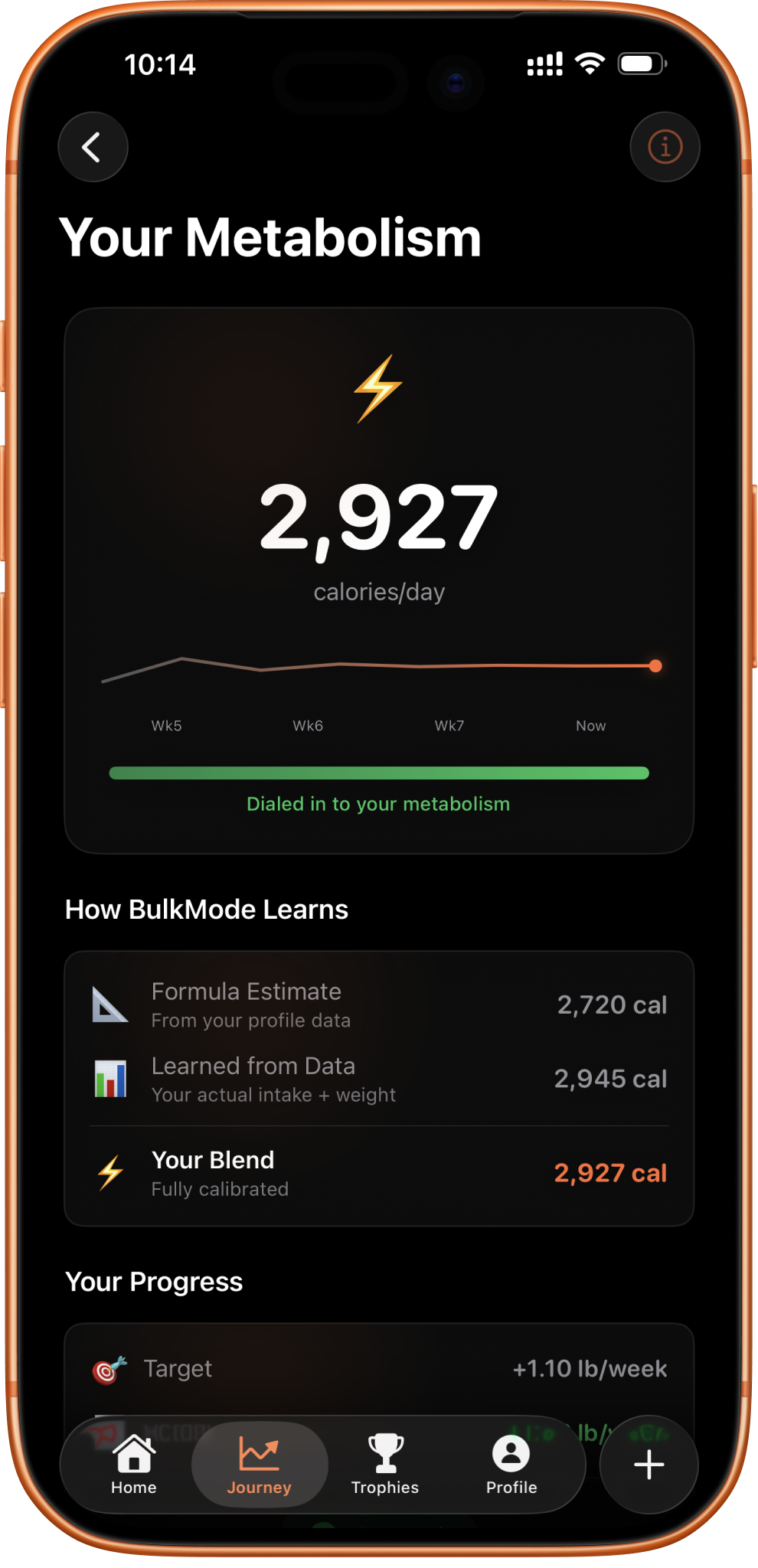
This loop is where BulkMode stops being a calculator. From around week three, it compares what you actually ate against what your weight actually did, and rebuilds the target from your own data instead of the formula's assumptions. It ramps you in, then learns your real number. Running the loop somewhere else? Most trackers won't move the target for you — here's what to look for.
Calories decide the weight. Protein decides what kind.
The surplus controls how fast the scale moves. Protein (0.7–1 gram per pound of body weight) and lifting control whether the new weight is muscle — how much protein to build muscle sets the exact gram target. If you're new to the whole method, the bulkmaxxing guide covers it end to end. And if you're already eating "a lot" and the scale still won't move, read why you can't gain weight — the answer is almost never your metabolism.
The number is the easy part.
You can get a target from this page in five minutes. The bulk is the eight weeks of hitting it, watching the trend, and adjusting without guessing. That's the part BulkMode does:
- Snap your food. Calories and macros, instantly. No searching, no typing.
- A target that moves with you. It starts at the formula, then learns your real maintenance from your weigh-ins.
- See the trend, not the noise. The scale wobbles day to day. Your real progress doesn't.
- No guilt for eating. No red warnings, no shame. Hitting your calories is a win, not a problem.