Around 0.25–0.5% of your bodyweight a week. In practice that's roughly 0.7 lb a week if you've been lifting under a year, about half that at one to four years in, and less again after that. Women build muscle at close to half the male rate, so the honest number is smaller for the same work. Above your ceiling, the extra weight is fat.
"As fast as possible" is the instinct, and it's the one answer that's definitely wrong. There is a rate above which extra calories stop turning into muscle. It's lower than most people expect, it's specific to you, and it's the single number that decides whether a year of eating was worth it.
Your ceiling isn't a matter of opinion
Muscle accrues at a rate your body sets. Not your appetite, not your surplus, not how badly you want it. Eat past that rate and the calories still land — they just land as fat. Training experience is the biggest input, then sex, then age. Rounded to what your scale will actually show:
- Under a year of lifting: about 0.74 lb a week for a man, 0.37 for a woman. The fastest window you will ever get, and it closes.
- One to four years in: about 0.37 lb a week for a man, 0.19 for a woman. Half the newbie rate, for identical effort.
- Four years and up: about 0.18 lb a week for a man, 0.09 for a woman. Advanced lifters gain in ounces, which is why they're so particular about them.
- Not lifting at all: call it 0.37 lb a week of useful gain. Without a training signal there's nothing telling your body to build with the surplus.
Age moves it too, by about 1% a year after 30 — a 40-year-old beginner is looking at 0.67 rather than 0.74, and a 55-year-old at 0.56. Slower, not different. Notably, height never enters any of this, despite being the field every generic calculator asks for first.
What that costs you in time
Twenty-five pounds at half a pound a week is fifty weeks. A year, near enough. That's the honest version of the answer, and most rate advice skips it because a year sounds like a sales problem.
It isn't, it's the whole reason the number matters. You're going to spend that year either way. The only question is whether you spend it building twenty-five pounds you keep, or twenty-five pounds you spend the following spring undoing. Pick the rate on that basis, not on how the first six weeks feel.
Why going faster doesn't finish sooner
Here's the trap. Double the surplus and the scale really does move twice as fast — that part is true. What doesn't double is the ceiling. Your body still builds muscle at its own rate, so everything above that arrives as fat, at roughly a pound of it per 3,500 surplus calories.
So you reach the same muscle at the same time, carrying weight you didn't ask for, and then owe months of eating less to get rid of it. That bill is the part nobody budgets for in week one. Clean bulk vs. dirty bulk runs the full comparison, but the short version is that the two styles are really just two rates with names attached.
The opposite failure is quieter and just as common. A surplus so cautious that nothing happens for two months isn't lean gaining, it's maintenance, carefully logged. If the weekly average hasn't moved in three weeks while you were genuinely hitting your target, your rate isn't conservative, it's zero — and that's a different problem with a different fix.
The slower the rate, the harder it is to see
There's a practical catch buried in all of this. At 0.37 lb a week you're trying to detect a third of a pound against daily swings of three or four pounds from water, salt and whatever you ate last night. The signal is smaller than the noise, every single morning.
So your rate isn't something you can check on a Tuesday. Weigh in most mornings under the same conditions, and compare this week's average against the average two or three weeks back. That comparison is the only place your real rate lives. Reading it off a single morning is how people conclude a working plan has failed, three weeks before it would have shown them otherwise.
When faster is genuinely the right call
All of the above assumes the goal is muscle. It isn't always.
If you're coming back from being underweight, total weight is the point and composition is secondary; getting to a healthy weight quickly is worth more than the make-up of every pound. BulkMode drops the rate caps entirely for that goal rather than quietly holding you to a lifter's ceiling.
And if you're a long way under where you should be and can't reliably eat enough to begin with, your practical ceiling isn't your muscle ceiling, it's your appetite. Hit the target first. Optimize the rate once hitting it has stopped being the hard part.
One honest note: if you're eating the target consistently and the scale still won't move over a month, or if any of this is turning food into something you feel anxious about, that's a conversation for a doctor or dietitian rather than a bigger number. See our health disclaimer.
Turning a rate into something you can eat
A rate is a decision. Calories are the implementation. Half a pound a week is roughly 250 calories a day over maintenance, so the arithmetic is trivial once you know your maintenance — which is the genuinely personal part. The bulking calorie calculator works both out from your bodyweight and body fat, and how many calories to bulk walks through where each piece of the number comes from.
After that, the only real work is checking week over week whether the rate you picked is the rate you're getting.
Picking the rate is easy. Hitting it is the job.
A rate you chose in week one is a hypothesis. The only thing that settles it is whether your weekly average is doing what you said it would, measured over months while you get on with your life. BulkMode does the measuring:
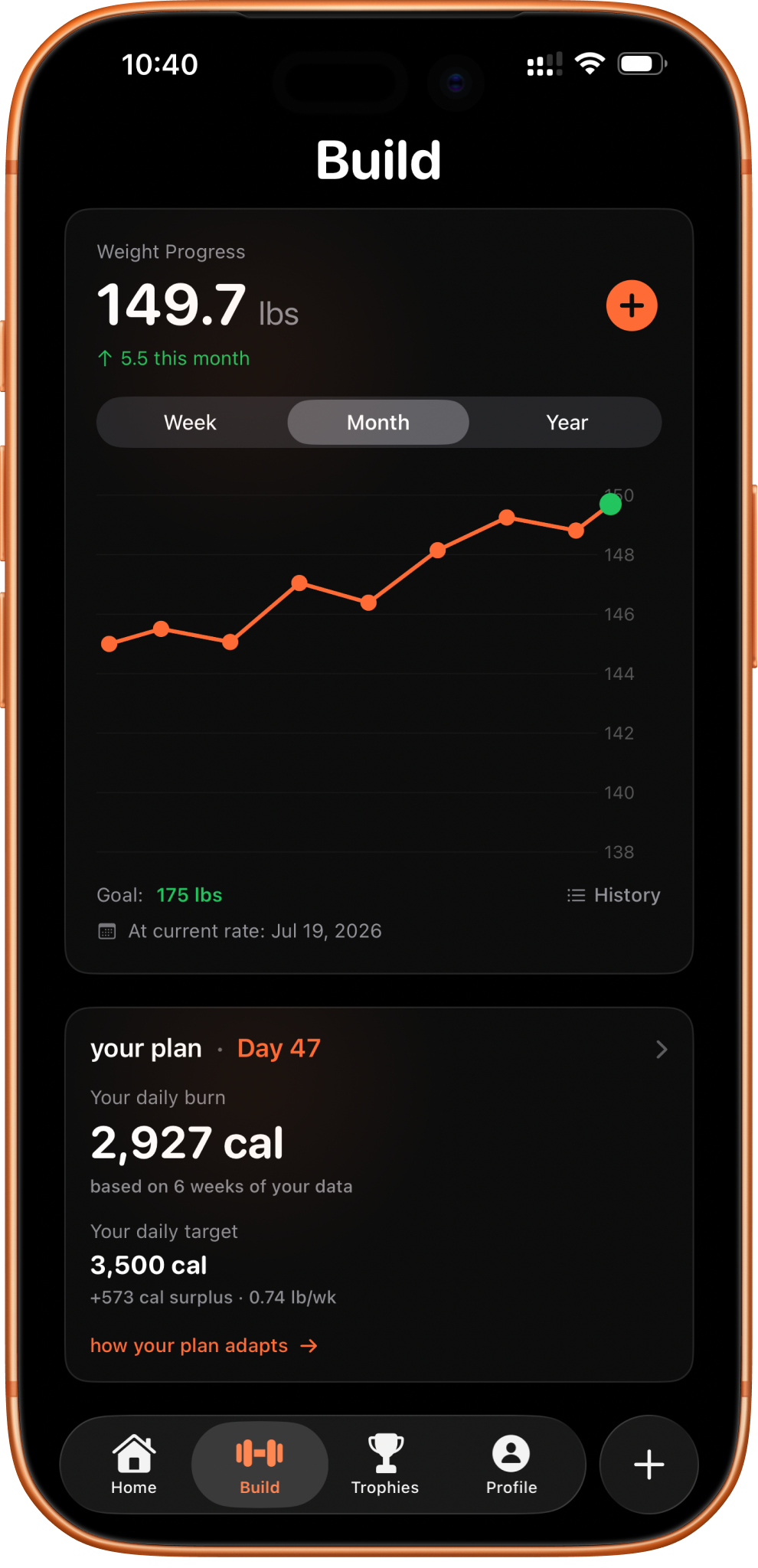
- The rate is on the screen, not buried in a setting. Your daily target shows the surplus and the weekly rate it's built to produce, side by side: +573 cal surplus · 0.74 lb/wk.
- You can't pick a rate your body can't use. The options are built from your lifting experience, age and sex, and anything above your ceiling never appears on the list. That's for muscle-focused goals — recovery from underweight keeps every option.
- A goal date from your weigh-ins, not your intentions. It fits a trend through your actual weight history and projects from that. Fewer than ten weigh-ins, or less than three weeks of them, and it shows nothing rather than a date it can't stand behind.
- Corrections stay small. When BulkMode later adjusts your target from your own data, it raises by at most 5% at a time and at most once every two weeks. A target that creeps upward feels like it's learning; one that jumps and walks back feels broken.