Almost nobody who struggles to gain weight has a damaged metabolism. They have a body that quietly burns more than average, an appetite that shuts off early, and an intake that's lower and less consistent than it feels. All three have fixes.
"But I eat so much"
Every hardgainer says it, and almost every hardgainer is wrong. Honestly wrong, not lying: research on self-reported eating shows people misjudge their intake by wide margins, and people trying to gain overestimate it. The enormous burger night is memorable. The skipped breakfast, the picked-at dinner, and the coffee that stood in for Tuesday's lunch aren't. Your memory keeps the highlights. The scale averages everything.
So start from the only rule with no exceptions: if your weight isn't going up, you're not in a calorie surplus. That's not a judgment. It's accounting.
Where the calories actually go
Your body fidgets the surplus away
A big share of your daily burn is movement you never notice: fidgeting, pacing, posture, taking the stairs without thinking. Researchers call it NEAT, and it varies by hundreds of calories a day between people of the same size. Worse for you, it tends to ramp up when naturally lean people overeat, quietly burning off part of the surplus. When someone says "fast metabolism," this is mostly what they're describing.
Your fullness gauge reads full too early
Appetite is a gauge, and yours is calibrated to keep you exactly where you are. Your fullness signals fire sooner than average, so the surplus that feels effortless to your friend feels like force-feeding to you. That's a thermostat doing its job, and you're about to override it.
Your week is quieter than your best day
Two big days and five forgettable ones average out to maintenance. You gain on the weekly average, not on your personal-record dinner. This is why so many people are certain they "eat a lot": they do, occasionally, and occasionally doesn't move a scale.
How to actually gain
1. Get a real target
Your maintenance plus 300–500 calories, every day. Full math in how many calories to bulk, or get your number in two minutes with the bulking calorie calculator. A vague intention to "eat more" is how you got here.
2. Eat by the clock, not by appetite
Your appetite is the broken gauge, so stop steering with it. Three meals and one or two snacks at fixed times, hungry or not. In a few weeks your appetite adapts to the schedule and this stops feeling like work. If you'd rather be handed the schedule, the bulking meal plan is three of those days written out.
3. Drink some of your calories
Chewing triggers fullness; drinking mostly doesn't, which makes liquid calories the biggest lever a hardgainer has. Whole milk with meals, a smoothie between them. Blend whole milk, peanut butter, a banana, and oats and you've added roughly 700 calories in five minutes, without touching your appetite for dinner.
4. Make meals denser, not bigger
A bigger plate fills you up. A denser one doesn't. Cook in olive oil, add nuts and nut butter, swap water for milk, granola over plain cereal. Same volume of food, hundreds more calories — high-calorie foods prices out every swap. If hitting the number at all is the real bottleneck, a looser approach is a defensible trade — clean bulk vs. dirty bulk covers when that's the right call and what it costs.
5. Lift, so the weight lands as muscle
A surplus without training mostly becomes fat. Three or four sessions a week of progressive lifting tells your body what to do with the extra calories. The full method is in the bulkmaxxing guide.
6. Track everything for two honest weeks
Log it all, including the days you'd rather not. This is where "I eat 3,000 calories" usually turns out to be 2,400 with good publicity. Two weeks is enough to end the mystery. The tracking doesn't stop there, because steering a bulk needs the data as long as the bulk runs. It just has to stop being hard, which is mostly a question of which app you use — see the best calorie tracker for bulking.
7. Judge the weekly trend, not the daily number
Day-to-day weight swings a few pounds on water and food timing alone. Weigh in regularly, watch the weekly average, and ignore everything else.
When it's actually medical
Sometimes it isn't NEAT or appetite. If you're losing weight without trying, your appetite has disappeared, you have ongoing gut symptoms, or the trouble started with a new medication, see a doctor before you see a calculator. Thyroid conditions, GI disorders, and some medications genuinely block weight gain, and no guide fixes those.
And one more honest note: if eating past fullness feels frightening or distressing rather than just tedious, that's worth talking through with a professional, not pushing through alone. Gaining weight should be boring, never upsetting. See our health disclaimer.
The tracking part, handled.
Hardgainers rarely quit because eating is hard. They quit because tracking is: weighing food, searching databases, typing entries three times a day. BulkMode removes the friction:
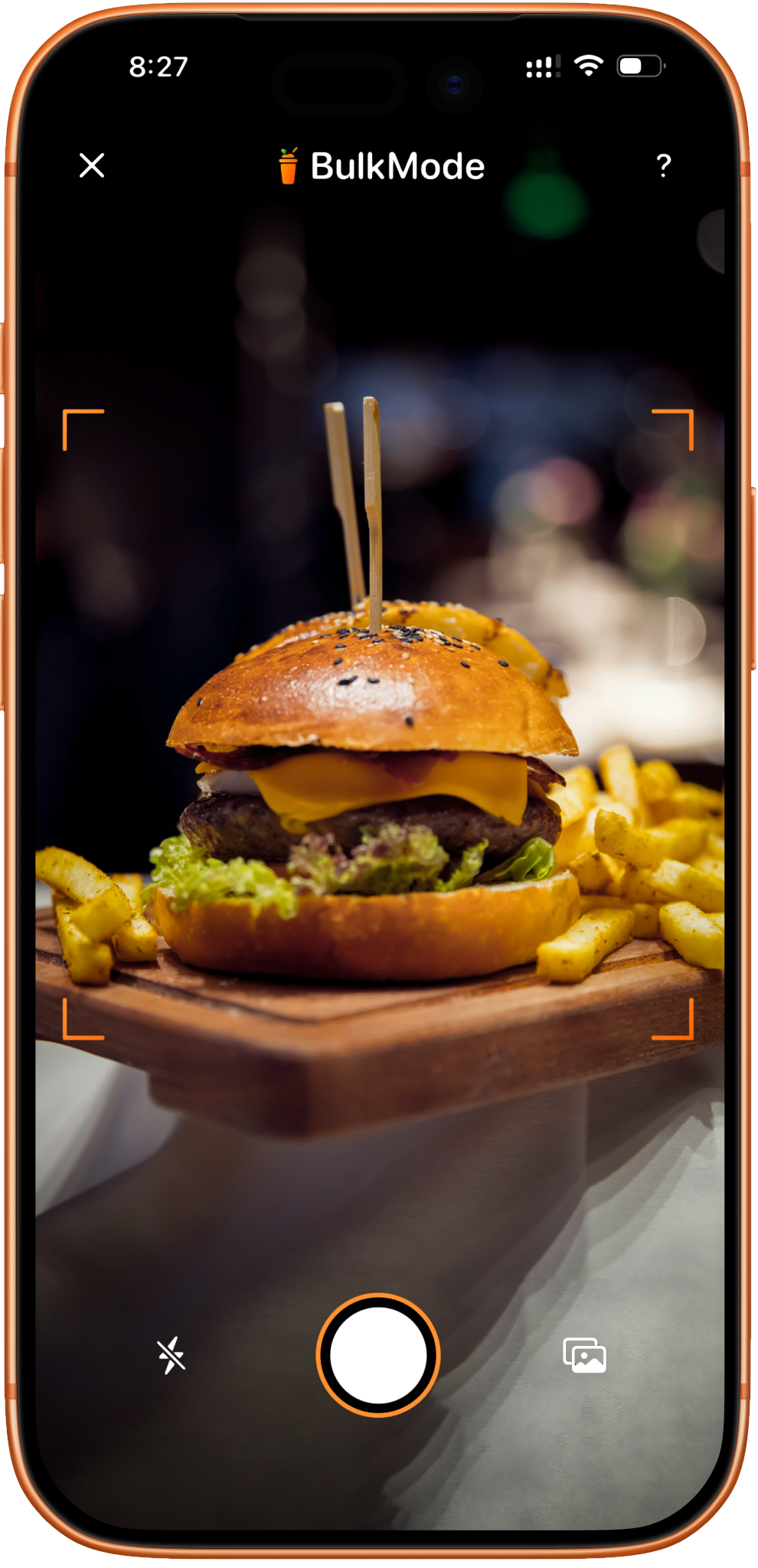
- Snap your food. Calories and macros from a photo, instantly. Logging takes seconds, so it actually happens.
- A target that learns your burn. It starts from a formula, then learns your real maintenance from your weigh-ins. If your body really does run hot, your target rises to match it.
- See the trend, not the noise. The scale wobbles day to day. Your real progress doesn't.
- No guilt for eating. No red warnings for going over, because going over is the goal. Most trackers are built for people eating less. This one isn't.