A plateau is almost never your body failing. It's your surplus disappearing. A heavier body burns more, so the target that gained you weight in week one is your maintenance by week ten — same food, no gain. The fix is a slightly bigger number, not a new plan.
This is the point where most bulks quietly end. Not from a dramatic failure, from six flat weeks and a slow conclusion that it isn't working. It is working. It's just finished working at that particular calorie count.
What eats your surplus
You got bigger, and bigger costs more
This is the main one and it's pure arithmetic. Every pound you add has to be maintained, warmed, and carried around all day. For a typical adult, maintenance runs somewhere near 14 calories per pound of body weight, so putting on ten pounds adds roughly 100 to 150 calories a day to the bill. Gain fifteen pounds on a 300-calorie surplus and you've spent more than half of it on the body you just built.
Digestion takes a cut
Roughly a tenth of what you eat is burned processing it. Eat 500 more, hand back 50. Small, permanent, and working against you the whole way up.
You started moving more without noticing
Unconscious movement — fidgeting, pacing, standing instead of sitting — tends to rise when you eat above maintenance, and it's worth hundreds of calories a day in some people. It's the same mechanism behind the fast metabolism hardgainers describe, only now it's showing up mid-bulk.
And, usually, your intake drifted
The unglamorous one, and the most common. Portions shrink as the novelty wears off. Weekends stop getting logged. The oil, the coffee milk, the bite of someone else's dinner all fall off the record. Six weeks in, "the same calories" is frequently 200 fewer calories with the same routine wrapped around it.
First, make sure it's real
Most reported plateaus are two bad weeks with a story attached. Body weight swings a few pounds day to day on water, salt, carbs and digestion, while genuine gain arrives at a couple of ounces a day. No single morning can show you the difference, which is why weight goes up in steps: flat for ten days, then two pounds overnight, then flat again.
So the bar is specific. Weigh in most mornings, under the same conditions, and compare this week's average to the average two or three weeks ago. If that comparison is flat while you were genuinely hitting your target, you have a plateau. If either half of that sentence is missing, you have a normal week.
Fix it in this order
1. Audit the log before you touch the calories
Weigh and log everything for one honest week, weekends included. If it turns out you've been eating 2,700 instead of the 3,000 on the plan, the fix isn't more calories, it's the ones you already committed to. Adding a further 200 on top of a 300-calorie accounting error just moves the error.
2. Then raise the target, by a little
If the logging is clean, add roughly 150–200 calories a day and hold it for two weeks before judging. Everyone wants to add 500 and settle it this week. That usually overshoots into fat, then gets pulled back, and a month later the target is swinging around instead of climbing. Slow and upward beats accurate and volatile — the calories guide covers how to size the raise against your gain rate.
3. Add it where it costs you nothing
Two hundred calories is a tablespoon of olive oil and a glass of milk, or half a handful of nuts. Don't build a sixth meal for it — high-calorie foods covers the add-ons that raise a day's total without raising how much food you have to face.
4. Check whether it's the training, not the food
If the scale is climbing again but nothing else is changing, the problem was never the surplus. Progressive overload, enough protein and enough sleep decide what the extra calories get built into. The bulkmaxxing guide covers that half.
5. Expect to do this again
A bulk isn't one number held for six months, it's a number that steps up every time your body catches it. Three or four raises across a long bulk is normal. Each stall is the system telling you it's time for the next one, not that you've hit some ceiling.
The one stall worth leaving alone
If you've been gaining faster than your chosen rate for a month — a pound a week when you picked half — a flat two weeks isn't a plateau. It's the average catching up with you, and the extra weight was going to arrive as fat anyway. Hold the target, keep logging, and let the trend line come back to your rate before you add anything. Picking a rate rather than a label is what makes that call obvious instead of a guess.
One honest note: if the stall came with real fatigue, appetite loss, or weight moving down without trying, that's a doctor's question, not a calorie question. See our health disclaimer.
The target was never a setting
Every calculator, ours included, gives you a starting guess built from population averages and your stats. The bulking calorie calculator will get you a defensible number in two minutes, and that number has an expiry date measured in weeks. What actually runs a bulk is the loop after it: eat the target, watch the weekly average, raise it when the average flattens. Plateaus are just what that loop feels like when nobody's running it.
This is the problem we built the app around.
Running the loop by hand means remembering to compare two weekly averages you never wrote down, then deciding how much to add without over-correcting. BulkMode does that part on its own data.
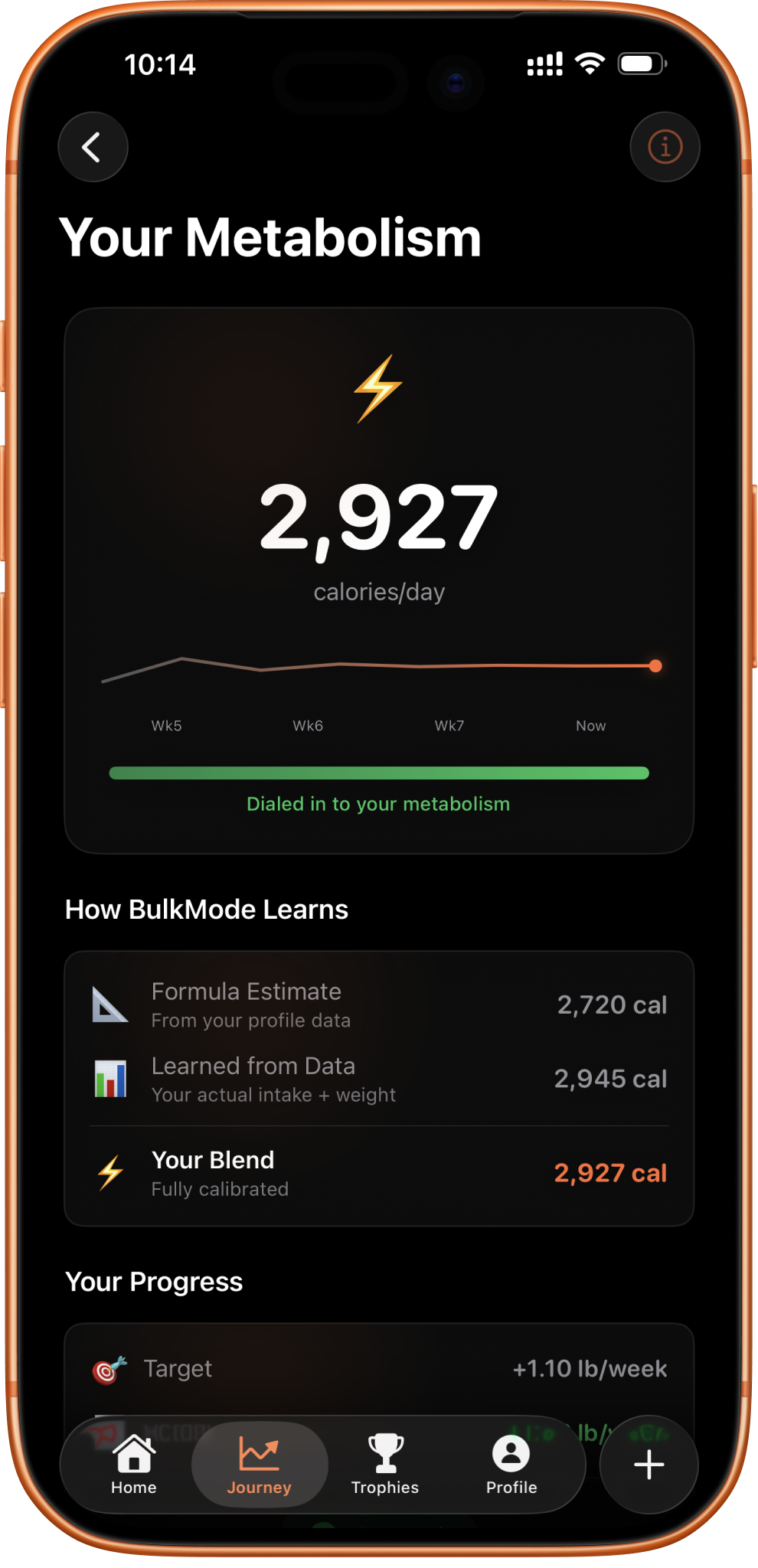
- It learns your real maintenance. After a couple of weeks it compares what you actually ate against what your weight actually did, and shows you all three numbers: the formula estimate, the one learned from your data, and the blend it's using.
- It flags the stall for you. When your real weekly rate drifts away from your target rate, a check-in appears with the exact calorie change and waits for you to accept it.
- The moves are deliberately small. At most a 5% raise at a time, at most one every two weeks, and smaller than that while it's still short on data. No jump up followed by a walk back.
- Five pounds gained rebuilds the plan. Sustained gain means a new maintenance, so it recalculates the target from your new body weight and asks you to confirm.