You don't need more food. You need denser food. Fat carries more than twice the calories of protein or carbs per gram, and water carries none — so the fastest way to add a thousand calories is to change what's on the plate, not how much fits on it.
Most people trying to gain are already eating to the edge of their appetite, which makes "eat more" useless advice. The useful version is a price list: what each calorie costs you in room, because room is the thing actually in short supply.
Density is the whole game
Calories come in three sizes. Protein and carbs run about 4 calories per gram. Fat runs 9. Water runs zero, and most food marketed as healthy is mostly water.
That's why the standard lean-eating plate — chicken breast, broccoli, a cup of rice — is close to the worst possible meal for gaining. It's around 600 calories and it will hold you for four hours. Cook it in two tablespoons of olive oil and add a handful of almonds and it's over 1,000, in the same space, in the same twenty minutes.
Density isn't a permission slip for junk. It's a constraint: every item on the plate has to earn its room.
What each food is worth
Fats and oils — the most calories per bite
- Olive oil — about 120 calories a tablespoon. Cook in it, then finish the plate with more.
- Butter — about 100 a tablespoon, and it goes on things oil doesn't.
- Peanut or almond butter — about 190 per two tablespoons, plus 8 grams of protein.
- Cheese — about 115 an ounce. Melts into food you're already eating.
Nuts, seeds and dried fruit — calories that travel
- Almonds, walnuts, cashews — 160 to 190 an ounce, which is a small handful.
- Trail mix — about 140 an ounce, and it lives in a bag in your car.
- Medjool dates — about 65 each. Four of them is a meal's worth of carbs in a minute.
- Granola — about 250 per half cup. The most efficient thing you can put on yogurt.
Dairy — the easiest 500 in the fridge
- Whole milk — about 150 a cup with 8 grams of protein. Three cups a day is 450 calories you barely notice drinking.
- Whole-milk Greek yogurt — about 220 a cup with 20 grams of protein.
- Chocolate milk — about 210 a cup. Unfashionable, effective.
Carbs that don't fill you up
- White rice — about 205 a cooked cup, and easier to eat in volume than brown.
- Pasta — about 220 a cooked cup, before anything you put on it.
- Bagels — about 290 each, roughly three slices of bread in one hand.
- Honey, maple syrup, jam — about 60 a tablespoon, added to something you're eating anyway.
Protein worth eating
- Salmon — about 350 calories and 40 grams of protein per 6-ounce fillet.
- 80/20 ground beef — about 290 per 4 cooked ounces, versus about 180 for the lean version.
- Whole eggs — about 72 each with 6 grams of protein. The yolk is the point.
- Chicken thighs over breast — same meal, a couple hundred more calories.
Chicken breast and egg whites aren't wrong. They're just doing half the job, and you need both halves.
Add-ons beat extra meals
A sixth meal is a chore you'll abandon by week two. An upgrade to a meal you're already eating is free.
- Cook in oil instead of spray — +120 to +240
- Whole milk instead of water in oats, shakes, coffee — +80 to +150
- A spoon of nut butter in the oatmeal — +190
- Cheese and avocado on the sandwich — +240
- Granola and honey on the yogurt — +315
- A handful of nuts after each meal — +500 a day
Pick three, do them without thinking, and that's 500 to 700 calories you never had to find room for. It's also the whole surplus for most people — the calories guide covers how to size yours, and the bulking calorie calculator gives you the number in two minutes.
Drink the difference
Chewing triggers fullness. Drinking mostly doesn't, which makes liquid calories the single biggest lever if your appetite is the bottleneck. One blender, five minutes:
- 2 cups whole milk — 300
- ½ cup dry oats — 150
- 2 tbsp peanut butter — 190
- 1 banana — 105
- 1 scoop whey — 120
- 1 tbsp honey — 65
That's about 930 calories and 55 grams of protein, and it won't touch your appetite for dinner. Commercial mass gainers do the same job out of maltodextrin and whey, and the difference is price per calorie rather than effectiveness. Buy one if convenience is genuinely what's stopping you.
A day that reaches 3,500
Nothing here is a project. Two of the five aren't cooking. (Want the full version? The bulking meal plan runs this day meal by meal, with a 3,000- and a 4,000-calorie day beside it.)
- Breakfast — three eggs fried in butter, two slices of toast with butter, a glass of whole milk. ~750
- Mid-morning — the shake above. ~930
- Lunch — rice bowl with chicken thigh, cheese, half an avocado, olive oil. ~1,000
- Afternoon — a handful of almonds and two dates. ~300
- Dinner — salmon and a cup of rice with oil. ~550
Roughly 3,500 calories and well over 180 grams of protein, and the largest single item is a drink. That's the shape of a day that works: dense meals, dense snacks, and one thing you don't have to chew. When it eventually stops moving the scale — and it will, once you're heavier — the answer is one more add-on, not a new plan. Why weight gain stalls covers when to make that call.
Where density goes wrong
- Protein gets crowded out. Fat and sugar are the easiest way to add calories, and it's simple to add 800 of them without a gram of protein. Hold 0.7–1 gram per pound of body weight first — how much protein to build muscle sets your exact number — then fill the rest with whatever is convenient.
- Fiber disappears. Go all-in on oil, white carbs and honey and your digestion will make the argument for you within a week.
- The ceiling doesn't move. Denser food makes hitting a surplus easy; it doesn't raise how fast you can build muscle. Overshoot and the extra lands as fat, exactly as it would from any other source — clean bulk vs. dirty bulk runs that math over twelve weeks.
One honest note: if you've got a medical condition, a food allergy, or eating past fullness feels distressing rather than just tedious, talk to a doctor or dietitian before building a plan around this list. See our health disclaimer.
Dense food is the hardest food to log.
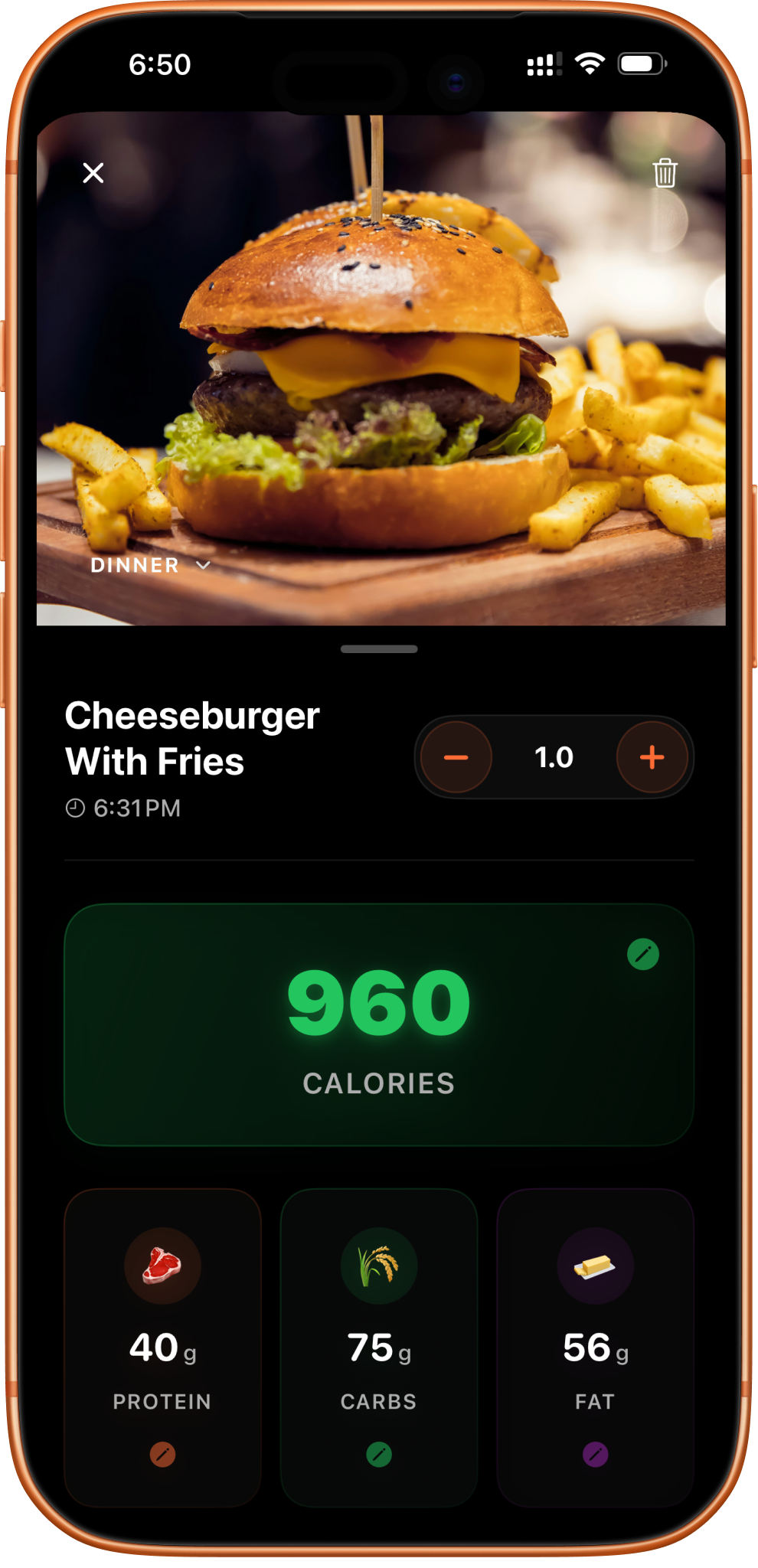
A chicken breast is easy to eyeball. Two tablespoons of olive oil, a handful of nuts and the third of an avocado you actually ate are not — and those are the exact calories you added on purpose. Miss them and your log says you're eating 2,800 while your body knows it was 3,400. BulkMode closes that gap:
- Snap the plate. Calories and macros from a photo in seconds, oil and all. No searching, no typing.
- Fix the portion in a tap. Ate one and a half? Nudge the multiplier instead of re-entering the meal.
- Save what you eat twice. Snap the shake once, then it's one tap every morning after.
- Going over is green. No red warnings, no shame. Hitting your calories is the win, not the problem.